University Management System: Transforming Higher Education Administration
Educational institutions have become increasingly complex to manage. Admissions, student records, attendance, examinations, fees, academic planning, human resources, libraries, hostels, transportation, research and institutional reporting all generate data and require coordination across multiple departments.
When these functions operate through disconnected applications, spreadsheets and manual processes, information often becomes fragmented. Staff spend more time transferring data between systems, administrators have limited visibility into operations, and decision-making can depend on incomplete or outdated information.
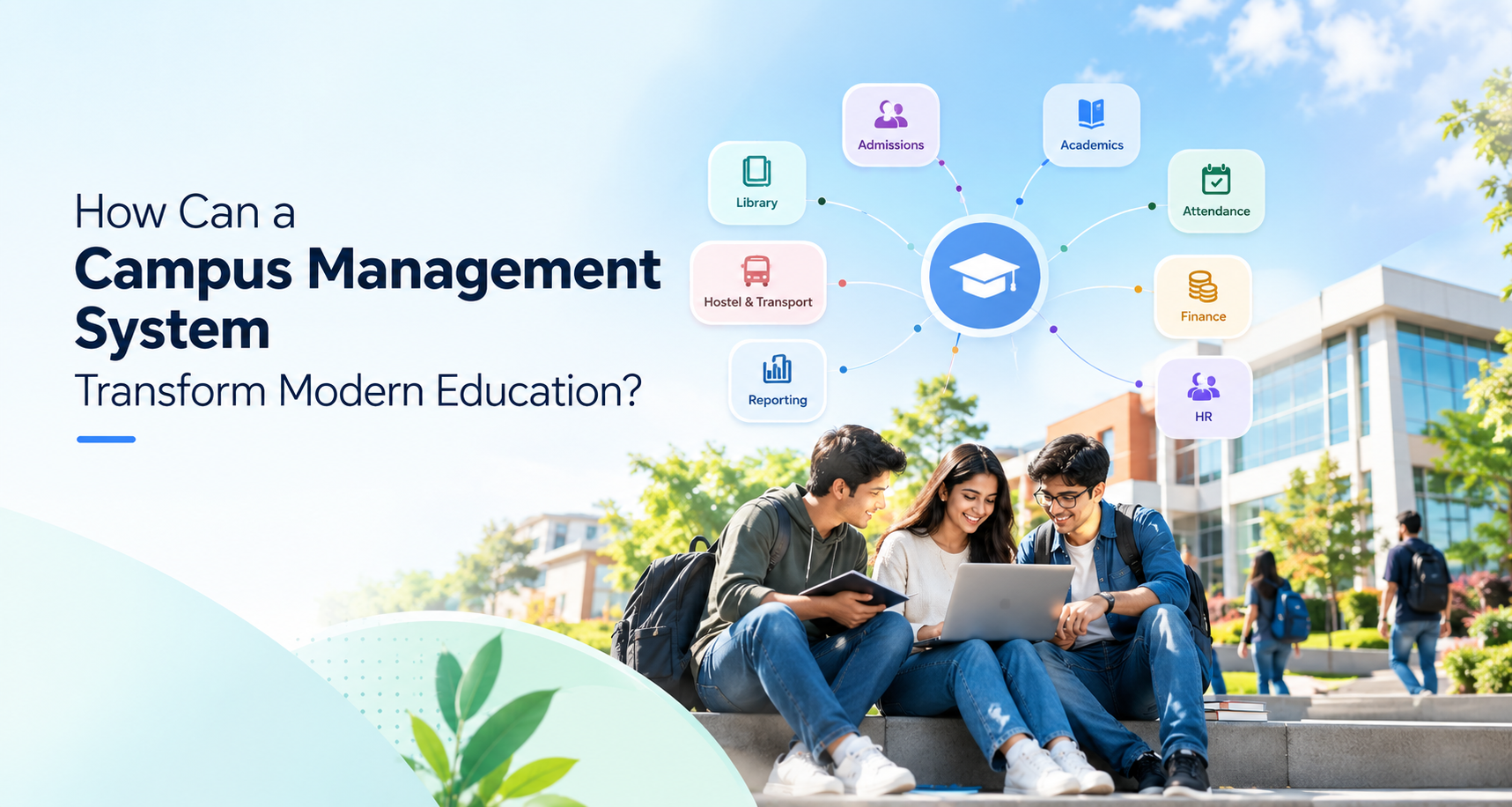
A campus management system addresses this challenge by bringing key academic and administrative functions together within a connected digital environment. Instead of treating each department as a separate operation, it creates a common framework through which institutional data, workflows and stakeholders can work together.
A campus management system is an integrated digital platform designed to coordinate the academic, administrative and operational activities of an educational institution.
Depending on the institution’s size and requirements, it can bring together functions such as:
The underlying idea is not simply to digitize individual tasks. It is to create connected workflows and a consistent institutional data environment.
For example, information captured during admission can become part of the student’s academic record instead of being entered again by another department. Similarly, attendance, examination and financial information can be accessed according to the permissions and responsibilities of different users.
Many institutions still rely on a combination of specialised software, spreadsheets, physical registers and manual communication. While these approaches may work at a smaller scale, they become increasingly difficult to manage as student numbers, departments and campuses expand.
An integrated system can address several common operational challenges.
When different departments maintain separate records, administrators may struggle to establish a single, reliable view of institutional information. Centralized data management allows authorized users to work with information from a common source. This reduces repetitive data entry and makes it easier to retrieve records when required.
Admissions, attendance, fee processing, examination administration and reporting often involve repetitive activities. Digital workflows can reduce unnecessary manual intervention. Routine processes such as registration, attendance recording, fee tracking and report generation can be structured into predefined workflows, allowing employees to focus more on activities that require judgement and interaction.
Institutional decisions often require information from several departments. A connected platform can provide dashboards and reports that bring relevant information together. Administrators can examine trends in attendance, academic performance, admissions, finances or other operational areas without manually consolidating data from multiple sources.
Students and faculty increasingly expect educational services to be accessible digitally. Online registration, fee payments, academic information, attendance records and institutional communication can make everyday interactions more convenient. This also becomes particularly important for institutions operating across multiple campuses or serving large student populations.
A comprehensive platform should go beyond basic student administration. Its value comes from connecting multiple functions while allowing each department to work according to its specific requirements.
Admissions are often the first major interaction between an institution and a prospective student. An integrated system can organize inquiries, applications, registration, document management and admission workflows. A connected enquiry and admissions process also makes it easier to track applicants through different stages and maintain a structured record of interactions.
Student information forms the foundation of many institutional processes. A centralized student record can contain personal information, academic history, registration details, attendance, examination results, financial information and other relevant records. Role-based access ensures that users see the information appropriate to their responsibilities.
Attendance is closely connected with academic monitoring and student engagement. A digital student attendance system can support different methods of attendance capture and provide authorized users with timely attendance information. When attendance data is integrated with other academic processes, institutions can reduce manual reconciliation and identify attendance-related concerns earlier.
Academic administration involves much more than maintaining course lists. Institutions need to manage programs, subjects, academic schedules, examinations, marks and results. An integrated platform can connect these activities and reduce duplication between academic departments and examination offices. Faculty can manage relevant academic information while administrators gain a broader institutional view.
Financial administration is another area where disconnected processes can create unnecessary work. A digital system can support fee structures, payments, scholarships, fines, receipts and financial reporting. Online payment capabilities can also reduce dependence on manual collection and reconciliation.
Institutions manage large communities of teaching, non-teaching and administrative employees. HR functionality can support employee records, recruitment, attendance, leave, payroll and other workforce processes. Connecting HR information with wider institutional operations can provide administrators with a more consistent view of staffing and resource requirements.
Libraries generate continuous transactional data involving books, users, issues, returns and resources. Integrating library operations into the broader institutional ecosystem can make information easier to manage while reducing the need to maintain separate records.
For residential and multi-campus institutions, hostel and transportation services are important operational functions. Digital workflows can support room allocation, student records, transport information, routes and related administrative activities. Connecting these functions with student records can also reduce duplicate data maintenance.
One of the most important advantages of integrated systems is the ability to convert operational data into usable information. Dashboards and reports can help administrators analyze areas such as:
The objective is not simply to generate more reports. It is to make relevant information available for better and faster decision-making.
Digitization and automation are related, but they are not the same!
Digitization converts paper-based or manual information into digital form. Automation goes a step further by allowing predefined processes to execute with less manual intervention.
For example, an institution may digitize attendance records but still require staff to manually prepare reports. With campus automation, the attendance data can feed directly into dashboards and predefined reports.
The same principle can apply to admissions, fee reminders, examination workflows, notifications and other recurring processes. The real value of automation therefore comes from reducing unnecessary handoffs while maintaining appropriate human oversight.
A well-structured campus management system can benefit more than the administration department. Its effectiveness depends on how well it supports different users across the institution.
A university ERP or college ERP can serve as the technological foundation for managing institutional resources and processes. In practice, the terminology varies between institutions and technology providers.
The more important consideration is not the label but the degree of integration.
A useful platform should allow information to move logically between related functions rather than creating isolated digital silos. It should also be flexible enough to accommodate differences in institutional structure, academic programs, workflows and reporting requirements.
Selecting a digital platform is a long-term institutional decision. The number of modules alone should not determine the choice. Institutions should evaluate some following areas before making the mind-
The next phase of campus management software is likely to focus less on simply storing information and more on using institutional data intelligently.
Cloud accessibility, mobile platforms, analytics, biometric integrations, digital communication and automation are already changing how educational institutions manage daily operations. The emerging focus is on connecting these capabilities so that data generated by one process can support another.
Artificial intelligence may further expand this model by helping institutions identify patterns, generate reports, support administrative queries and surface information that may otherwise remain buried in large datasets. However, technology should complement institutional decision-making rather than replace human judgement.
The long-term objective should be a campus environment where information flows efficiently, routine processes require less manual intervention and decision-makers have reliable information when they need it.
A modern campus is too interconnected to be managed effectively through isolated systems and repetitive manual processes. Admissions influence student records, attendance connects with academic monitoring, examinations generate institutional data, and financial and administrative activities affect almost every department.
A well-designed campus management system brings these relationships into a structured digital environment. Its real value lies not in the number of features it offers, but in how effectively those features work together.
For educational institutions evaluating digital transformation, the priority should be clear: build a connected information ecosystem that improves operational efficiency, strengthens data visibility, and supports better experiences for students, faculty, and administrators.
This approach is reflected in solutions such as campus management CRM from Sonet Microsystems, which brings academic, administrative, financial, HR, library, attendance and other institutional functions into an integrated environment.
 Chat on WhatsApp |
  Email us