
Examination Management System: 10 Ways to Improve Assessment Accuracy, Fairness and Accountability
By Sonet Microsystems
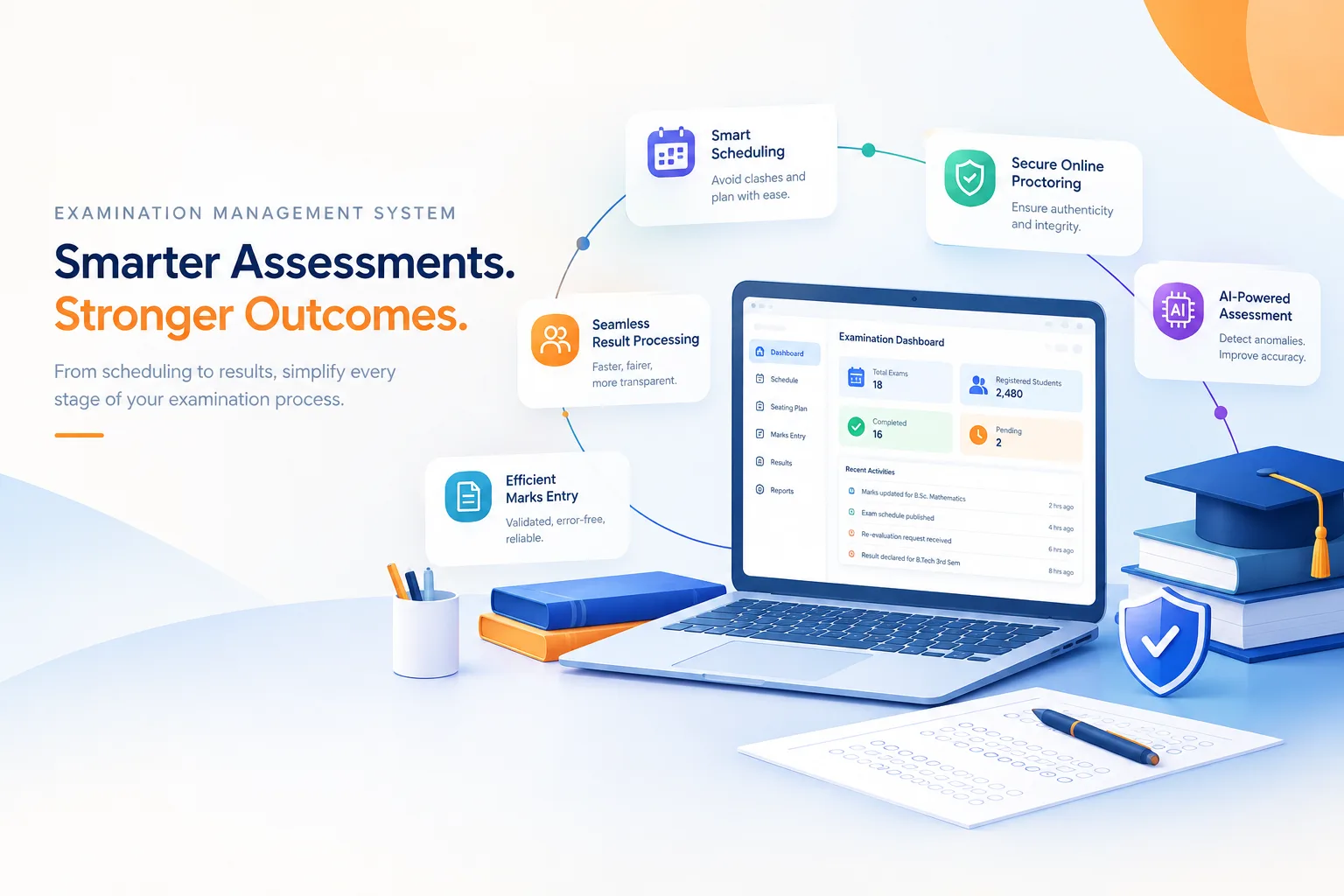
An examination result carries more than a student's marks. It influences academic progression, eligibility for further study, institutional credibility, and the confidence students place in their institution. Yet, producing a reliable result requires far more than conducting an examination on a scheduled date. Student eligibility must be verified, timetables must avoid conflicts, examination rooms must be allocated appropriately, marks must be recorded accurately, and every correction must follow an authorised process.
When these activities are managed through disconnected spreadsheets, paper registers, email approvals, and separate applications, the risk of inconsistencies increases. A timetable revision may not reach every affected department. A marks entry error may remain undetected until results are published. A re-evaluation request may require staff to search across several records before determining its status.
The challenge is therefore not simply to digitise examinations. It is to establish a dependable process in which every stage follows defined rules, relevant information remains connected, and important decisions can be traced.
An effective examination management system helps institutions achieve this by bringing examination planning, student records, scheduling, evaluation, grading, and result processing into a coordinated workflow. More importantly, it helps academic administrators identify where errors can occur, establish controls before those errors affect results, and maintain accountability when exceptions arise.
Examination Reliability Begins Before the Exam Day
Institutions often focus on examination-day arrangements because that is when operational problems become most visible. However, many examination issues originate much earlier.
A student may be registered for the wrong paper. A timetable may create a clash between two examinations. Room allocation may exceed seating capacity. An invigilator may be assigned to overlapping sessions. Marks may be entered against an incorrect roll number.
Each issue can affect the fairness or reliability of the final result.
A well-structured examination management system helps prevent these problems by connecting relevant academic records with examination workflows. Course registrations can inform candidate lists, room capacity can guide seating plans, and defined validation rules can help identify inconsistencies before results are finalised.
The aim is to move from correcting problems after they occur to detecting preventable errors at the stage where they originate.
This distinction matters for universities, colleges, and schools managing large candidate volumes, multiple examination sessions, different assessment formats, and frequent timetable changes.
The Examination Process Is a Chain of Accountability
An examination passes through several hands. Academic departments confirm requirements, examination cells prepare schedules, administrators allocate rooms, invigilators supervise candidates, evaluators assess responses, and authorised officials approve results.
Each stage depends on information produced earlier and creates information needed later.
If the process is poorly connected, accountability becomes difficult to establish. Staff may not know which timetable is final, which marks have been verified, or whether a result correction has received the required approval.
An examination management system can establish a clearer chain of accountability through role-based access, validation rules, status tracking, and structured approval workflows. The precise controls vary by platform, but the principle remains the same: every important action should have a defined owner, and sensitive changes should follow institutional rules.
This becomes particularly important during re-evaluation, disputed marks, examination rescheduling, and result corrections. These situations require more than a functioning application. They require reliable records of what changed, why it changed, and who authorised the decision.
Top 10 Capabilities That Strengthen Examination Management
The most useful examination technology is not necessarily the platform with the longest feature list. It is the one that addresses the points where errors, delays, and inconsistencies are most likely to arise.
1. Conflict-Aware Examination Scheduling
Creating an examination timetable involves balancing course combinations, candidate availability, room capacity, faculty responsibilities, and examination durations. In institutions with multiple programmes or elective combinations, avoiding clashes can become a substantial administrative task.
An examination management system can use relevant enrolment and availability data to help generate schedules while identifying conflicts before publication. When a room or examination slot changes, administrators should be able to assess which other arrangements are affected.
The value lies in reducing avoidable clashes and giving the examination cell a more reliable basis for publishing the final timetable.
2. Automated Seating Plans and Room Allocation
Seating arrangements must account for room capacity, candidate numbers, examination sessions, and institutional rules intended to reduce opportunities for malpractice.
Preparing these arrangements manually across multiple rooms and floors can consume considerable staff time. It can also lead to inconsistent application of seating rules.
Automated seating plan generation can allocate candidates according to defined constraints, including separation of students from the same class or section where required. Invigilator assignments and room utilisation can be coordinated within the wider scheduling process.
The final arrangements should remain reviewable by authorised staff, especially when accessibility requirements or exceptional circumstances require adjustments.
3. Reliable Candidate and Eligibility Records
Before a student sits an examination, the institution must establish which papers the student is registered for and whether the applicable eligibility requirements have been met.
These requirements may involve course registration, attendance rules, fee-related policies where applicable, or approved academic exceptions. When information is maintained separately, administrators may need to verify the same details across several records.
A connected examination management system can use relevant student and academic data to support candidate verification and eligibility reporting. Institutions should configure these checks according to their approved policies rather than relying on assumptions built into generic software.
4. Controlled Question Paper and Assessment Workflows
Assessment preparation involves confidentiality, version control, approval, and timely distribution. Institutions need to ensure that the correct paper reaches the intended examination session without exposing restricted material to unauthorised users.
Digital workflows can help manage permissions, approvals, document versions, and access to assessment materials. Where question banks are supported, they can also help faculty organise questions by subject, topic, difficulty, or learning outcome.
These capabilities should be supported by appropriate access controls and institutional security procedures. Digitisation alone does not guarantee confidentiality.
5. Validated Marks Entry
Marks entry is one of the stages where a small data error can create a disproportionate administrative burden.
A transposed digit, an incorrect roll number, or a value outside the permitted range may affect a student's result. If such errors remain undetected, the institution may face complaints, correction requests, and delays in issuing final records.
An examination management system can introduce validation checks for permitted score ranges, required fields, and inconsistent entries. Where supported, separate responsibilities for marks entry, verification, and approval can provide additional control.
The purpose is not to remove faculty judgement from evaluation. It is to reduce avoidable administrative mistakes around the marks that evaluators award.
6. Automated Grading and Result Processing
Institutions may use percentages, grade points, credit-weighted calculations, or programme-specific grading rules. Calculating results manually becomes increasingly difficult as the number of candidates, subjects, and academic combinations grows.
Automated result processing can apply configured grading schemes consistently and generate the relevant result records once the required marks and approvals are complete.
Before deployment, institutions should test the system against real academic scenarios, including backlog examinations, reappear papers, moderation, grace marks where permitted, and corrected entries. A calculation is only reliable when the configured rules match the institution's approved regulations.
7. Secure Online Examination and Proctoring
Online assessments create flexibility for remote learners and digitally delivered programmes, but they also introduce questions about identity verification, unauthorised resources, and the integrity of examination conditions.
Online proctoring can support examination security through controls such as browser lockdown, tab-switch detection, webcam monitoring, and candidate-specific question randomisation, depending on the platform and assessment design.
Institutions evaluating online proctoring tools for exam delivery should consider more than the number of monitoring features available. They should also examine accessibility, device compatibility, connectivity requirements, data handling, student communication, and procedures for reviewing flagged incidents.
Monitoring alerts should not automatically be treated as proof of misconduct. Technical interruptions, environmental conditions, and legitimate student actions may require human review before an institution reaches a conclusion.
8. AI-Assisted Assessment With Human Oversight
AI can support examination workflows by assisting with question generation, identifying unusual marks patterns, or helping evaluators organise and review assessment information.
For example, an unexpectedly high or low mark may warrant a verification check. AI-assisted anomaly detection can help identify such entries for review before results are published.
However, an unusual score does not automatically indicate an error, and automated analysis should not replace academic judgement. The context of the subject, assessment method, and student's performance must be considered.
A responsible ai assessment approach defines what the technology can assist with, which decisions remain with faculty, and how recommendations are verified. Institutions should also evaluate transparency, consistency, and the risk of incorrect flags before relying on AI-supported processes.
9. Structured Re-Evaluation and Result Correction
Examination responsibilities do not end when results are published. Students may request re-evaluation, scrutiny, or correction under the institution's applicable policies.
Without a defined workflow, requests can move through emails, physical applications, and departmental registers without a consistent view of their status. Staff may have to reconstruct the history of a case before deciding the next action.
A digital workflow can record the request, track its progress, assign responsibility, and maintain relevant approvals and outcomes. Where a correction is authorised, the revised record should be reflected in the appropriate academic documents and reports.
This creates a clearer process for students and administrators while supporting accountability for decisions made after result publication.
10. Examination Analytics and Institutional Reporting
Examination data can reveal patterns that are difficult to identify from individual result sheets. Course-level performance, recurring backlogs, result processing timelines, and differences across assessment cycles may help academic leaders identify areas for further investigation.
An examination management system can consolidate relevant data into reports and dashboards, reducing the need to compile figures manually from separate files.
These insights should be interpreted carefully. A low pass rate, for example, may reflect assessment difficulty, curriculum coverage, student preparedness, or several factors together. Analytics can indicate where investigation is needed, but they do not automatically explain the cause.
When used appropriately, examination reporting can support academic review, process improvement, and more informed institutional planning.
Why Examination Data Should Not End at Result Publication
A final result is not merely an endpoint. It becomes part of the student's academic history and may influence progression, graduation, eligibility, and future institutional decisions.
When examination records connect with student information, academic management, and the wider education management system, the institution can reduce repeated data entry and maintain greater consistency across departments.
For example, a finalised result can feed the relevant student record, while approved grade corrections can update the appropriate academic documents. Examination performance may also contribute to programme reviews and learning outcome analysis.
Integration with a learning management system can strengthen this relationship further. Course enrolment and assessment activity may inform relevant examination workflows, depending on the systems and integration rules in place.
The objective is to ensure that information generated during assessment remains useful beyond the examination cell, while access to sensitive records remains controlled.
What Institutions Should Evaluate Before Choosing a System
Selecting an examination platform requires an understanding of the institution's academic regulations, assessment formats, existing technology, and operational constraints.
Before making a decision, institutions should examine the following:
Workflow coverage: Does the platform support scheduling, seating, marks entry, grading, result publication, and post-result requests?
Rule configuration: Can it accommodate the institution's grading schemes, eligibility rules, backlogs, and re-evaluation policies?
Data validation: Can it identify missing, inconsistent, or out-of-range entries before they affect results?
Access and accountability: Are responsibilities clearly assigned, with suitable controls for sensitive records and changes?
Online assessment security: Are proctoring capabilities appropriate to the assessment format, accessibility needs, and institutional policy?
Integration: Can examination data connect with student records, academic modules, and the LMS without unnecessary duplication?
Implementation and support: Does the provider offer data migration, staff training, testing, and support during examination cycles?
The right exam management software should be assessed using actual institutional scenarios, not just a standard product demonstration. Testing a timetable change, a disputed marks entry, or a re-evaluation case can reveal how well the platform handles the situations that matter most.
Connecting Examination Operations With the Wider Institutional Ecosystem
Examinations interact with admissions, academic planning, student records, learning delivery, and institutional reporting. Treating them as a standalone administrative activity can create unnecessary gaps between departments.
A connected examination management system helps institutions coordinate these relationships through shared records and defined workflows. It can reduce repetitive tasks while giving authorised users a more consistent view of examination activity.
Sonet Microsystems' examination management capabilities support scheduling, seating plans, marks entry, grading, result processing, and re-evaluation workflows. Its online proctoring capabilities extend the process to browser-based security controls, monitoring, question randomisation, and review of flagged incidents. AI-assisted examination automation can also support question preparation, marks anomaly checks, and result analytics, with final academic decisions remaining under institutional oversight.
These capabilities form part of a broader institutional technology environment rather than a separate collection of examination tools. Their value depends on how well they fit the institution's regulations, connect with relevant academic records, and support the people responsible for conducting and reviewing assessments.
Conclusion
Reliable examinations depend on consistent decisions at every stage, from candidate eligibility and timetable preparation to evaluation, result publication, and correction. A weakness in any one stage can affect the credibility of the entire process.
An examination management system helps institutions establish stronger controls around these activities, reduce preventable errors, and maintain a traceable record of important decisions. When integrated with student records, academic workflows, and digital assessment tools, it can also make examination data more useful to the wider institution.
The goal is not automation for its own sake. It is to create an examination process that is accurate, accountable, and adaptable to the institution's academic requirements.
Explore Sonet Microsystems' examination management and exam proctoring solutions to understand how connected workflows can support more dependable examination operations across educational institutions.