
University ERP: Managing Academic Complexity Across the Modern University
By Sonet Microsystems
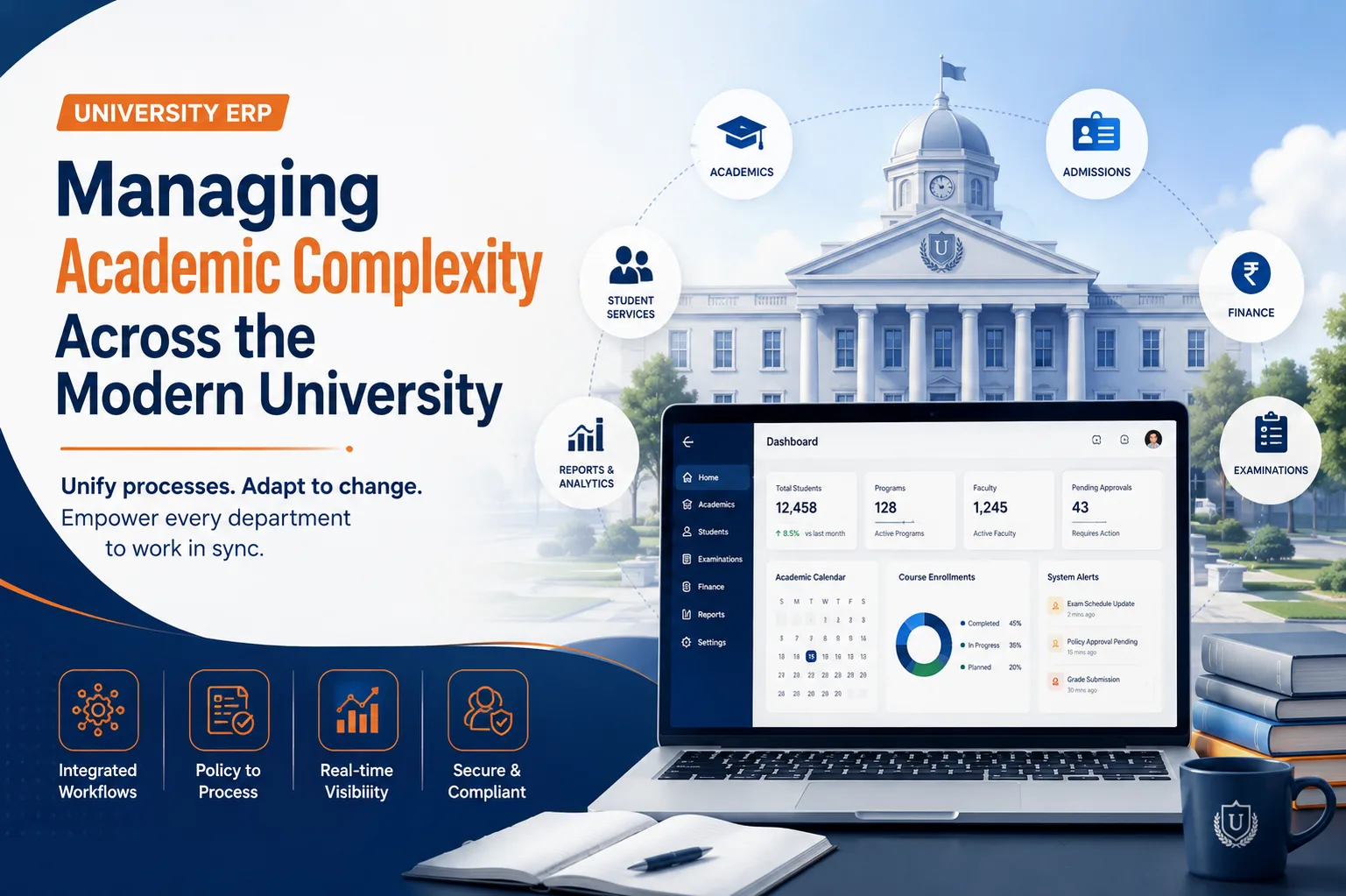
Universities are designed to operate within defined academic rules, but their day-to-day operations rarely follow a perfectly predictable path. A student changes a course combination after registration. A university revises its examination schedule. A new programme introduces different credit requirements. A faculty member submits assessment data after a deadline, while the examination department is already preparing results. Each situation may appear manageable in isolation, yet its consequences can extend across several departments.
These situations expose a fundamental challenge in higher education: how can a university maintain consistent operations when its academic requirements, administrative decisions, and institutional responsibilities continually interact?
Traditional digital systems often handle routine transactions reasonably well. The difficulty emerges when an exception, policy change, or unusual academic scenario requires multiple departments to coordinate their responses. If every change depends on emails, spreadsheets, repeated data entry, and manual approvals, the institution becomes increasingly difficult to manage as its programmes and campuses expand.
A well-designed university ERP can help address this challenge by connecting institutional rules, records, approvals, and operational workflows. Its purpose extends beyond digitising administrative tasks. It helps universities establish a structured way to manage both routine processes and the variations that naturally occur throughout an academic year.
For institutions adapting to multidisciplinary programmes, evolving credit structures, digital learning, and growing reporting responsibilities, this capability deserves greater attention when evaluating technology investments.
Why Routine Processes Are Not Enough to Test an ERP
Most software demonstrations focus on a straightforward sequence: register a student, record attendance, enter marks, process fees, or generate a report. These activities are important, but they reveal only part of a system's capabilities.
The real test begins when a process deviates from its expected sequence.
Consider a student who registers for an elective and subsequently changes the selection. The change may affect the course roster, faculty workload, timetable allocation, learning management system enrolment, assessment eligibility, and examination records. If these systems operate independently, every affected department may need to update its own information.
A similar challenge occurs when a university introduces a revised academic rule. Administrators must determine which programmes and student batches are affected, when the rule becomes applicable, who is authorised to approve exceptions, and how the change should be reflected in existing records.
A university ERP should help institutions manage these dependencies through defined workflows, configurable rules, and controlled access to information. Where integrations are supported, a change in one process can trigger the necessary updates or notifications in connected systems.
This does not mean every exception should be automated. Academic decisions involving eligibility, appeals, special permissions, or regulatory interpretation may require human review. The objective is to ensure that the review follows a documented process and that its outcome is reflected consistently across the institution.
For university leadership, this distinction is important. Efficiency is not simply about processing routine transactions faster. It is also about reducing the confusion, duplication, and risk that arise when circumstances change.
Academic Regulations Must Translate into Operational Workflows
Universities operate under academic regulations that determine programme structures, course eligibility, credit requirements, assessment methods, examination rules, and progression criteria. These regulations become meaningful only when they are applied consistently in everyday operations.
A policy document may define a requirement clearly, but implementing it across admissions, academics, examinations, and student records is a different challenge.
For example, a university may revise the credit requirements for a programme. The academic department must interpret the revised structure, the registration process must accommodate the applicable requirements, and the examination system must evaluate students according to the correct rules. Historical records may also need to remain available under the regulations applicable to earlier batches.
A university ERP can provide a common operational framework for translating approved requirements into system configurations and workflows. The exact capabilities depend on the platform, but the institution should be able to define relevant academic structures, assign permissions, manage approvals, and preserve records of completed transactions.
This becomes particularly important in universities that operate multiple constituent colleges, departments, campuses, or academic frameworks. A central administration may need consolidated visibility while individual departments retain responsibility for their authorised activities.
The right university management system should therefore accommodate both institutional consistency and legitimate academic variation. Standardising every process without considering programme-specific requirements can be as problematic as allowing every department to maintain entirely separate procedures.
Managing Student Progression Across Complex Academic Structures
Student progression is not always a linear movement from admission to graduation. Credit accumulation, elective choices, backlogs, reappear examinations, programme transfers, approved breaks, and changes in academic regulations can create different pathways through the same institution.
When student records are fragmented, administrators may struggle to establish a reliable picture of an individual's academic status. A course may appear completed in one record but remain pending in another. An examination registration may not reflect a recent course change. A student may require an eligibility review that depends on several semesters of academic history.
An integrated university ERP can help by maintaining connected records of programme registration, course enrolment, attendance, assessments, examination results, and academic progression.
The benefit is not that software makes academic decisions automatically in every case. Rather, it allows authorised staff to review a student's status using consistent information and apply the relevant rules with less dependence on manual reconciliation.
Universities should assess how a system handles situations such as:
Students carrying backlogs across semesters.
Course additions, withdrawals, and elective changes.
Programme transfers and changes in student status.
Re-evaluation and corrected examination results.
Different academic rules for different admission batches.
Exceptions requiring approval from a department, dean, or academic authority.
These scenarios provide a more meaningful evaluation than a generic demonstration of student registration. They reveal whether the system can support the institution's actual academic structure.
From Examination Processing to Academic Accountability
Examinations connect academic regulations with student outcomes. They involve scheduling, course eligibility, attendance requirements where applicable, question papers, assessment, marks entry, moderation, result processing, and publication.
A delay or discrepancy at one stage can affect subsequent activities. Incorrect registration data may create eligibility issues. Late marks entry can delay result processing. An approved correction may need to be reflected in the student's academic history and relevant reports.
A university ERP should support traceable examination workflows, from registration and scheduling to grading and result publication. Universities should examine how it handles authorisation, validation, corrections, and the movement of information between departments.
Auditability is especially important. Institutions should be able to determine who made a change, when it occurred, which approval was required, and how the final record was established. This creates a stronger basis for resolving disputes and maintaining accountability.
Examination data can also contribute to academic review. Patterns in course results, backlogs, and progression may prompt departments to investigate assessment practices, student support requirements, or curriculum delivery. Such findings require contextual interpretation, but reliable data makes that review more practical.
A university management system software platform should therefore be evaluated not only on whether it can generate results, but also on whether it supports the controls and traceability surrounding those results.
Connecting the ERP with Digital Learning
Academic complexity now extends beyond the boundaries of the traditional classroom. Universities increasingly use digital platforms to deliver course materials, conduct assessments, manage assignments, and monitor learner progress.
However, the learning environment depends on accurate institutional information. Students must be associated with the correct courses, faculty need relevant class rosters, and assessment information may need to connect with formal academic records.
When an ERP and LMS operate separately, institutions can end up maintaining enrolment information twice. Changes to course registration may not be reflected immediately in the learning platform, while assessment data may require manual transfer into academic records.
Integrating a university ERP with an LMS can reduce these gaps by allowing relevant enrolment and course information to move between systems. Depending on the integration, assessment and learning outcome data can also support academic reporting and quality assurance.
For universities evaluating the best LMS for university requirements, this connection deserves as much attention as course creation, online assessments, virtual classrooms, and learner analytics. A platform that offers extensive learning features may still create unnecessary administrative work if it cannot exchange information effectively with the institution's core systems.
The same principle applies when comparing lms systems for education. The right choice depends on the institution's teaching model, accessibility requirements, assessment needs, integration capabilities, and academic reporting objectives.
Sonet's Knowledge Setu is positioned as an AI-native LMS for higher education, with support for digital course delivery, assessment, learner performance insights, and integration with UniSCOP or ESCOP for relevant enrolment and outcome information. This creates an opportunity to connect teaching activity with wider academic operations instead of treating digital learning as an isolated service.
Making Institutional Reporting More Dependable
University leadership requires information that is timely, consistent, and traceable. Yet management reports often depend on figures compiled from different departments, each with its own data sources and reporting schedules.
A consolidated dashboard can improve visibility into admissions, examinations, finance, HR, and other operational areas. However, the value of a dashboard depends on the reliability of the information behind it.
If two departments use different definitions for the same indicator, combining their figures will not automatically produce a meaningful result. If source records are incomplete, the resulting report may present an incomplete picture with an appearance of precision.
A university ERP should help establish common data structures and reporting practices while preserving the context of each indicator. Authorised users should be able to investigate figures, identify their underlying records, and understand when information was updated.
This is particularly relevant when institutional leadership reviews enrolment performance, outstanding fees, examination outcomes, programme demand, staffing requirements, or resource utilisation.
The best university ERP is not necessarily the platform with the most dashboards. It is the platform that helps decision-makers trust the information they receive and trace important findings back to dependable operational records.
Universities should also distinguish between descriptive reporting and predictive analysis. Historical data can reveal patterns, while AI-enabled analytics may help identify emerging risks or trends. Neither should be treated as a substitute for institutional judgement, especially when decisions affect student progression, academic eligibility, or resource allocation.
Accreditation Should Draw on Normal Institutional Activity
Accreditation preparation can become a separate administrative burden when departments begin collecting evidence only after a reporting deadline approaches.
Academic records, assessment results, course outcome mapping, faculty information, research activity, and student progression may all contribute to quality assurance, depending on the applicable framework. When these records are maintained across disconnected systems, the institution must spend additional time locating, validating, and consolidating them.
A more sustainable approach is to capture relevant information as part of normal institutional operations.
For example, course outcome mapping can be maintained during academic planning, while assessment results contribute to the review of learning outcomes. Research and project records can be updated throughout the year rather than reconstructed later. Quality teams can then use validated institutional data to prepare reports and identify missing evidence.
An integrated university ERP, supported by suitable IQAC and accreditation capabilities, can help make this process more consistent. The institution still needs to interpret regulatory requirements, validate evidence, and review submissions. Technology supports the process but does not independently guarantee compliance or accreditation outcomes.
For university leadership, the advantage is operational continuity. Quality assurance becomes connected to everyday academic work rather than an activity that depends on periodic data collection from multiple departments.
Choosing Technology Around Institutional Complexity
Universities comparing university management solutions should begin with the operational situations that create the greatest friction. These may include academic rule changes, complex examination requirements, multi-campus reporting, fragmented student records, or duplicated enrolment between the ERP and LMS.
The evaluation should then examine whether a platform can address those specific problems.
A practical assessment should include:
Academic configuration: Can the system accommodate the university's programmes, credit structures, electives, academic calendars, and examination rules?
Exception handling: Can authorised users process special cases through documented approvals without bypassing essential controls?
Cross-system integration: Can the ERP exchange relevant information with the LMS, admission systems, finance applications, and other institutional platforms?
Data governance: Are roles, permissions, validation rules, and change histories appropriate for the university's responsibilities?
Institutional reporting: Can decision-makers access consolidated information and trace important indicators to source records?
Implementation readiness: Does the provider offer structured data migration, validation, department-specific training, phased deployment, and continuing support?
The best institute ERP for a higher education institution should fit its actual governance and academic requirements rather than forcing the university into a rigid, generic template.
Institutions may also encounter the phrase campus management software during their research. Whatever terminology a vendor uses, the important consideration is whether the platform can connect campus administration with academic and institutional processes without creating additional data silos.
Implementation Determines Whether Integration Works in Practice
Technology selection is only one part of a successful transformation. Even a capable university ERP can create disruption if implementation does not account for existing data, academic calendars, departmental responsibilities, and staff readiness.
Legacy records may contain duplicate entries, inconsistent formats, or incomplete information. Different departments may follow different approval practices. A simultaneous rollout across every function may place unnecessary pressure on staff, particularly during admissions or examinations.
A structured implementation approach begins by mapping current workflows, identifying data-quality issues, defining responsibilities, and deciding which processes should be standardised. Historical information should be migrated with validation, and staff training should reflect the tasks each department performs.
Phased deployment can help the institution test workflows, address issues, and prepare teams before additional modules go live. Ongoing support is equally important because practical questions often emerge after staff begin using the system in everyday situations.
Sonet's 360° university management system approach includes data migration, department-specific staff training, phased go-live, and ongoing support. These elements help address the organisational side of digital transformation, where successful adoption depends on how well technology fits the institution's working environment.
A useful measure of implementation success is whether the university can manage routine transactions and exceptional cases reliably, with less duplication and clearer accountability.
Building a Connected University Technology Environment
Universities do not need to force every institutional activity into one interface. They need the systems responsible for those activities to exchange the right information and support the same institutional objectives.
A connected education management system can bring together admissions, student records, academics, examinations, finance, HR, digital learning, and quality assurance within a coherent technology environment. Each function retains its own responsibilities, while shared information reduces avoidable coordination gaps.
This is what distinguishes a unified digital ecosystem from a collection of separate university solutions. The value comes from how effectively the systems work together, how reliably they manage changes, and how well they support institutional governance over time.
Sonet Microsystems' UniSCOP provides a university-focused platform for academic and administrative operations, while Knowledge Setu extends the environment into digital teaching, assessment, and learning analytics. The wider 360° approach includes the implementation activities required to move from existing processes to connected workflows.
For universities planning digital transformation, the priority should be to identify the operational dependencies that matter most, then evaluate whether the proposed technology can manage those dependencies without adding unnecessary complexity.
Conclusion
A university's complexity is not limited to the number of students, departments, or campuses it manages. It also comes from the relationships between academic rules, individual student journeys, administrative decisions, and institutional responsibilities.
A well-implemented university ERP helps institutions manage these relationships through connected records, structured workflows, controlled exceptions, and more dependable reporting. Its value becomes particularly clear when circumstances change and the university needs to maintain consistency across several functions.
Rather than evaluating software only through routine demonstrations or feature comparisons, universities should test how well a platform responds to real academic scenarios, policy changes, and cross-department dependencies.
The objective is to build a digital environment in which technology supports institutional complexity instead of adding to it. When academic operations, administration, learning, and reporting work together, universities can spend less effort reconciling processes and more effort improving the quality and effectiveness of higher education.