
University Management System: From Fragmented Operations to Unified Campus Management
Sonet Microsystems ଙ୍କ ଦ୍ୱାରା
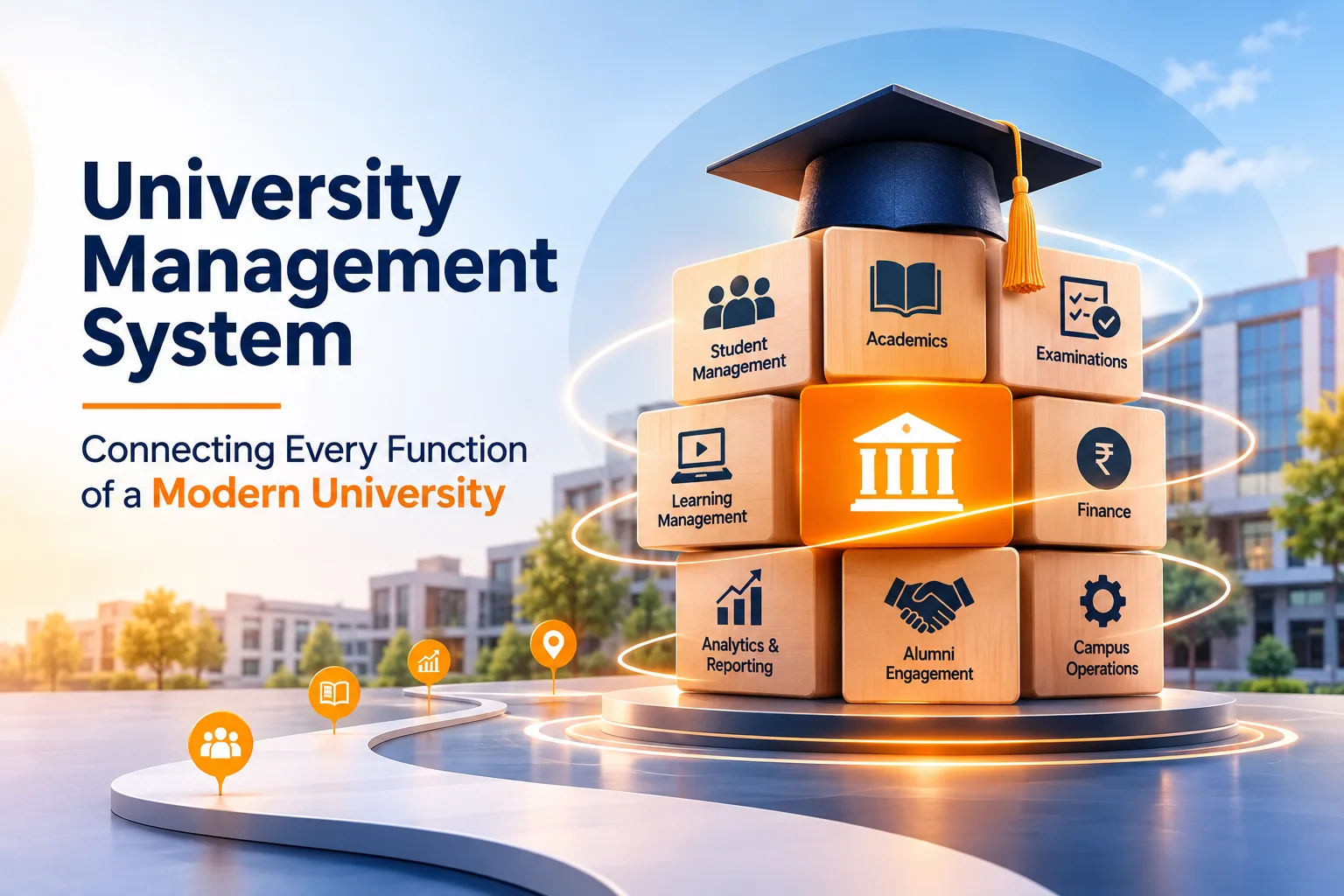
A university rarely has a shortage of information. It has admission enquiries, application records, student profiles, attendance entries, examination results, fee transactions, faculty records, research activity, learning data and institutional reports. The real challenge is making these pieces of information work together.
A decision taken in one department often changes what another department needs to do. A student changes a programme, an elective is added, a fee concession is approved, an examination is rescheduled or a result is revised. Each event has consequences across the institution. When the information sits in separate applications, spreadsheets and departmental records, people spend valuable time reconciling what should already be connected.
This is where a university management system becomes more than an administrative tool. It acts as the operating layer that connects the university's people, processes and information. Its value is not simply that it digitises individual tasks. Its real value lies in helping the institution function as one coordinated academic environment. In that sense, a university management system is the connective infrastructure behind institutional work, not merely a digital register of it.
A University Is a Network of Connected Decisions
Consider a student's journey. It begins with an enquiry, moves through application and admission, and continues into programme registration, course selection, attendance, assessment, fee management and graduation. After graduation, the relationship may continue through alumni engagement, mentoring and placement networks.
Each stage creates information that matters later. Admission data becomes the foundation of the student record. Programme and course registration shape timetable and examination eligibility. Attendance and assessment contribute to academic progress. Financial records influence fee clearance. Results and credit information support progression and award decisions.
A well-designed university management system keeps these connections intact. A university management system should preserve the context behind each record, so a later decision can be based on the same verified information as the earlier one. Instead of asking each department to recreate or re-enter information, it allows authorised teams to work from a consistent institutional record.
This continuity is especially important for universities with constituent colleges, multiple campuses, varied programme structures or large student populations. The central administration needs an institution-wide view, while individual departments and campuses need the flexibility to manage their own responsibilities. A connected system supports both levels without creating separate versions of the same information.
What University Management Software Should Actually Solve
The purpose of university management software is not to put every activity behind a login screen. It is to reduce the operational distance between one action and the next.
For example, when an applicant is admitted, the student's verified information should move into the student record. Course registration should inform academic planning. Timetable allocation should account for programme, elective, faculty and room constraints. Attendance should be available for academic monitoring and examination eligibility. Examination results should update the student's academic history and support progression decisions.
This is the difference between a collection of digital tools and a connected university management system. A university management system should reduce hand-offs, not create another layer of administration. In the first, staff move information between systems. In the second, information moves through approved workflows, with access and accountability defined by role.
A mature platform should therefore be evaluated by the quality of its connections, not just the number of modules it offers. This is a defining test of a university management system: can it carry information reliably from one institutional function to the next?
The Core Functions That Keep the Institution in Sync
1. Admissions That Establish a Reliable Student Record
Admission management covers more than application forms. Universities need to capture enquiries, manage applications, verify documents, prepare merit lists, allocate seats and complete enrolment. A connected university CRM can organise prospective-student communication, follow-ups and application progress, helping admission teams understand where each applicant stands.
Once admission is confirmed, the information should become part of the student's institutional record rather than being entered again by another department. This creates a dependable starting point for every subsequent academic and administrative process.
2. Academic Administration Built Around Programme Complexity
Universities manage multiple faculties, departments, programmes, semesters, courses, electives, credit structures and academic calendars. These are not static lists. They change with curriculum revisions, new programme launches, multidisciplinary combinations and institutional policy.
A university management system should help administrators maintain programme structures, plan course offerings, allocate faculty, create timetables and track academic delivery. It should accommodate the institution's academic model instead of forcing every department into a rigid template.
This becomes increasingly relevant as institutions implement flexible curricula and credit-based learning. The National Education Policy 2020 envisages multidisciplinary pathways, flexible curricular structures and multiple entry and exit options. The Academic Bank of Credits framework supports credit accumulation and transfer between recognised higher education institutions. These developments make accurate, accessible academic records and dependable programme administration essential. The policy direction is set out in the National Education Policy 2020 (NEP 2020), while the UGC Academic Bank of Credits (ABC) framework provides for credit accumulation and transfer.
3. Attendance and Examinations That Share the Same Context
Attendance is useful when it informs action. A reliable university attendance system should do more than record presence. It should provide department-wise and course-wise visibility, support attendance review and connect relevant information with examination eligibility.
Examination management then takes the process forward through exam scheduling, seating plans, marks entry, grading, result processing, backlog and re-evaluation workflows. When attendance, course registration and examination records are connected, the institution can reduce repetitive verification and improve the consistency of academic records.
4. Learning That Is Connected to Academic Administration
A learning platform should not operate as a separate island. Faculty need to manage course materials, assignments, assessments and learner progress. Students need a consistent way to access resources, submit work and understand their academic progress.
The best LMS for university environments is not simply the platform with the longest feature list. It is one that supports the institution's teaching model and connects learning activity with relevant academic information. When the LMS works alongside the university management system, course enrolment, learner identity and academic progress can be aligned more effectively.
5. Finance, People and Campus Operations Under One View
Fee structures, scholarships, concessions, instalments, online payments and reconciliation all contribute to a student's financial record. HR and payroll, staff attendance, leave, hostel allocation, library circulation, transport, inventory and asset management support the wider functioning of the campus.
A connected campus management system software environment helps departments coordinate these responsibilities while giving authorised administrators a consolidated view. The goal is not to centralise every decision. It is to ensure that information required by another department is available without repeated requests, manual collation or conflicting records.
From Departmental Reports to Institutional Intelligence
One of the most important functions of a university management system is the way it changes institutional visibility. It shifts the institution from periodic information collection towards a more continuous understanding of its operations.
A report is often treated as an output: someone requests information, a department collects it, a spreadsheet is prepared and the report is shared. But when data is generated as part of everyday workflows, reporting can become a continuous management resource.
University leadership can examine admission trends, enrolment patterns, fee status, attendance, examination outcomes, programme performance, staff information and campus-level activity through structured dashboards and MIS reports. The value lies in being able to ask better questions: Which programmes are seeing changes in enrolment? Where are students struggling to progress? Are examination outcomes consistent across departments? Which operational processes need attention?
The Ministry of Education's All India Survey on Higher Education collects institutional information on teachers, student enrolment, programmes, examination results, finance and infrastructure. This illustrates how varied institutional data contributes to understanding the higher education landscape. Within a university, organised records can similarly support internal planning, review and evidence-based decisions. The All India Survey on Higher Education (AISHE) provides a national example of how varied institutional data contributes to understanding the higher education landscape.
A higher education management system should therefore make information useful beyond the department that first records it. In practical terms, a university management system should help leadership connect operational activity with academic outcomes. It should help decision-makers understand relationships between academic delivery, student progression, resources and institutional performance.
Why Integration Matters More Than Having More Software
Universities often adopt tools to solve immediate needs: one application for admissions, another for online learning, a separate examination tool and different software for finance or communication. Each may work well independently. The difficulty appears when information needs to pass between them.
Disconnected systems can lead to duplicate student records, inconsistent programme details, delayed updates, repeated data entry and reports that do not agree. Staff become the link between applications, manually checking whether one system reflects what has happened in another.
This is why university management solutions should be assessed as an ecosystem. A university management system should connect these specialised tools through shared records and carefully defined workflows, rather than simply placing them under one vendor name. A student management system should connect with academic, examination and fee processes. The LMS should recognise the right courses and learners. Admission information should flow into verified student records. Quality and accreditation data should be drawn from the work already happening across departments.
The best university ERP is not necessarily the one with the most modules. It is the one that fits the university's structure, connects its essential workflows, maintains reliable records and can adapt as programmes, campuses and policies evolve. The same principle applies when comparing university management system software or university management software: integration, usability, data governance and implementation quality matter as much as functionality.
A Unified Digital Environment for the Modern University
A modern university management system should provide a common digital foundation while allowing specialised capabilities to work together. This can include:
University ERP: Admissions, student information, academics, examinations, fees, HR and payroll.
Learning management: Course delivery, learning resources, assignments, assessments and learner progress.
Admission CRM: Enquiry capture, application tracking, follow-ups, merit lists and enrolment.
Quality and accreditation workflows: Continuous data capture, outcome mapping and structured reporting for IQAC, NAAC and NBA requirements.
Campus operations: Hostel, library, transport, inventory, assets and facilities.
Research, placement and alumni engagement: Project records, publications, recruiter activity, placement processes and graduate networks.
Portals and mobile access: Role-specific information and services for students, faculty, staff and administrators.
This is the thinking behind a connected higher education management software ecosystem. Each capability has a defined purpose, but the institution benefits when they share accurate information and consistent workflows. These are the practical foundations of effective campus management software and integrated university solutions.
What Universities Should Examine Before Choosing a System
Selecting a university management system is a long-term institutional decision. The right university management system should reflect how the university operates today while accommodating the way it expects to grow. A university management system must be adaptable enough to support that evolution without fragmenting institutional data.
A product demonstration may show attractive screens, but the more important questions concern how the system will work within the university's actual structure.
Academic flexibility: Can it handle multiple programmes, semesters, electives, credits, departments and campus structures?
Data continuity: Does information flow between admissions, student records, attendance, examinations, finance and learning?
Role-based access: Can students, faculty, administrators and central leadership access the information relevant to their responsibilities?
Reporting and traceability: Can authorised users retrieve reliable records and understand how information was updated?
Scalability: Can the system support new programmes, constituent colleges and additional campuses?
Implementation support: Does the provider take responsibility for data migration, department-wise training, phased deployment and ongoing support?
Integration readiness: Can the platform work with relevant learning, identity, payment and academic services?
The implementation model deserves particular attention. Even capable software can underperform if historical data is migrated without validation, users are not trained for their actual roles or every department is expected to change its processes overnight. A phased rollout, supported by data checks and practical training, helps make adoption manageable.
How Sonet Brings University Operations Into One Connected Environment
Sonet Microsystems approaches university digitisation through an integrated ecosystem built around UniSCOP, its cloud-based university management system for higher education. The platform connects admissions, student information, academic and curriculum management, timetables, examinations, fees, attendance, HR and payroll, library, hostel, transport, inventory, research, training and placement, alumni engagement and accreditation-related workflows.
Its purpose is to give departments a shared operational foundation while providing role-based access and management visibility across the institution. Learning management can work alongside ERP processes, while continuous IQAC data capture and outcome mapping help institutions maintain structured information for quality review. Student and staff portals provide access to relevant services, and multi-campus capabilities support universities that need both local administration and central oversight.
The 360° university management approach also recognises that technology implementation is an institutional change, not simply a software installation. Sonet's rollout support includes legacy data migration, department-wise staff training, phased go-live and ongoing assistance. This helps universities plan the transition around their operational realities rather than treating deployment as a one-time handover.
For institutions looking to modernise without adding another disconnected application, an integrated university management system can provide a common foundation for administration, academics, learning and campus operations.
The Real Measure of a Connected University
A university does not become digitally mature because every department uses software. It becomes more coordinated when information is dependable, processes connect across functions and people can act without repeatedly searching for the same answers.
That is the larger role of a university management system. It supports the student journey, connects academic and administrative responsibilities, gives leadership a clearer view of institutional activity and creates the flexibility to respond to changing models of higher education.
The objective is not technology for its own sake. It is a university where the systems behind learning, administration and decision-making work together, so the institution can spend less effort managing fragmented processes and more effort advancing its academic purpose.
ଏହି ଭାଷାରେ ମଧ୍ୟ ଉପଲବ୍ଧ English