
Beyond Administration: How School ERP Is Powering the Connected School
By Sonet Microsystems
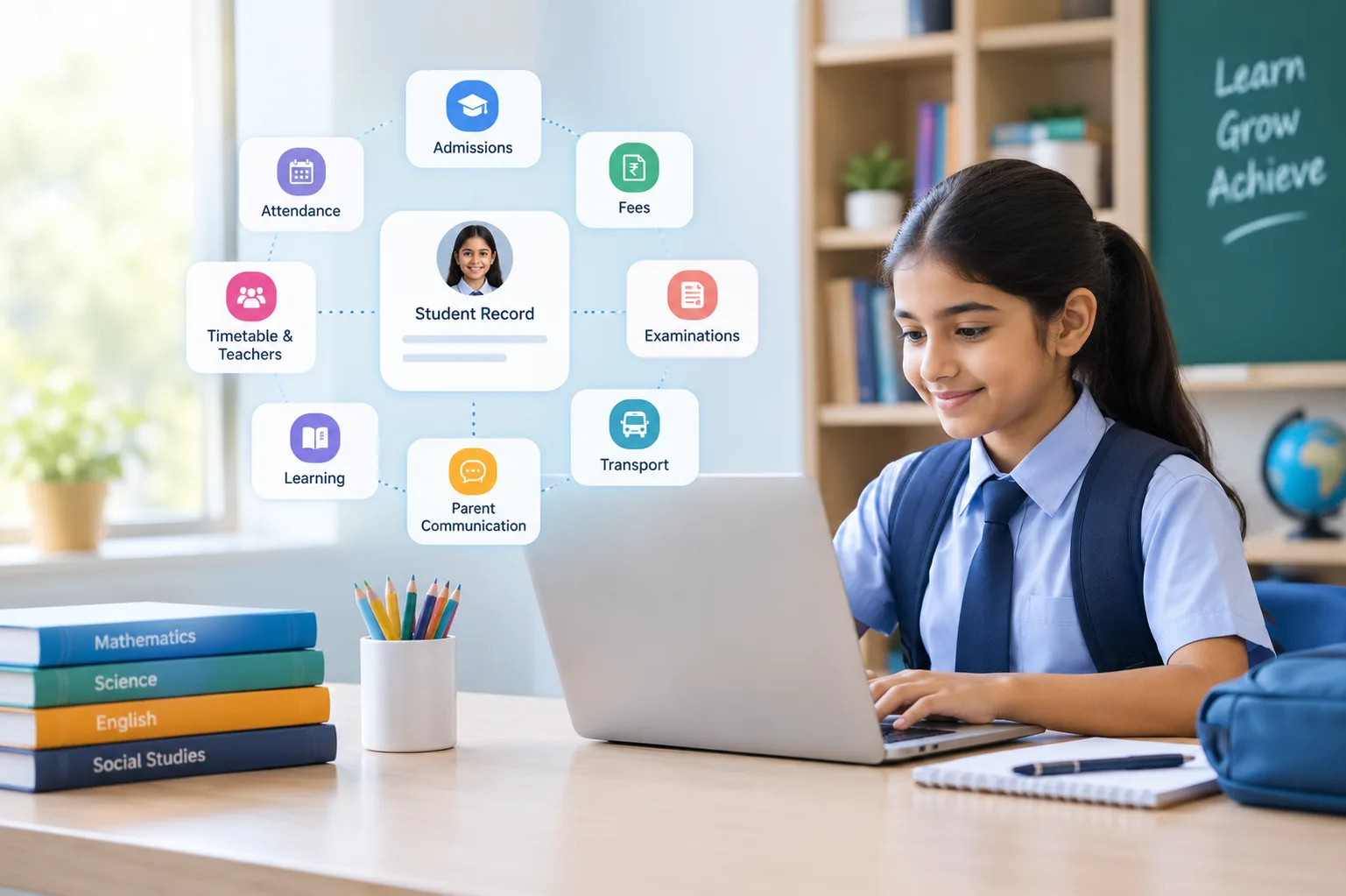
A school does not operate through isolated departments. A student's attendance affects parent communication; a timetable affects teaching and syllabus coverage; an assessment becomes part of the report card; a fee status may affect administrative follow-up; a transport change can require an immediate parent notification. Yet, in many schools, the information behind these activities still moves through separate registers, spreadsheets, messaging groups, applications, and departmental systems.
That fragmentation creates a problem that is bigger than manual paperwork. It prevents the school from maintaining one reliable view of what is happening across its academic and administrative operations.
A modern school ERP addresses this gap by creating a connected digital operating layer for the institution. Instead of treating admissions, student records, fees, attendance, examinations, transport, communication, and learning as independent functions, it allows them to work from a common institutional data structure. For K–12 schools, this is particularly important because the operating model revolves around classes, sections, subjects, teachers, terms, parents, and age-specific academic processes rather than the programme and semester structures commonly used in higher education. Sonet's eSSMS is specifically structured around this class-section-subject model and the term-by-term rhythm of school operations.
The real value of a school ERP, therefore, is not the number of modules it contains. It is how effectively those modules work together.
The Real Challenge Is Not Digitisation. It Is Fragmentation.
Most schools have already adopted some form of technology. The challenge is that technology often exists in disconnected pockets.
One application may handle attendance. Another may collect fees. Teachers may use a separate tool for homework. Parents may receive updates through SMS or WhatsApp. Transport may be tracked through another system, while examination data remains in spreadsheets.
Each solution may work reasonably well on its own.
The difficulty begins when these systems need to exchange information.
A student changes sections. A new teacher takes over a class. A bus route changes. A parent updates contact information. A subject teacher records assessment marks. A student is absent. A report card needs to be generated.
When information is maintained independently, every change creates another administrative task.
This is where a school management system needs to evolve beyond being a collection of digital forms. Its purpose should be to maintain continuity between the activities that make up the school day.
A useful way to think about the modern model is:
One student record → multiple connected workflows → one consistent institutional view
That principle is more important than simply moving paper processes onto screens.
Why K–12 Needs a Different ERP Architecture
A school is not a smaller university.
Its operational structure is different. Students are organised primarily by class and section. Subjects, periods, teachers, academic terms, examinations, co-scholastic activities, transport arrangements, and parent communication all operate around that structure.
A system designed around a higher-education model and simply adapted for schools can therefore create unnecessary complexity.
A purpose-built school ERP should understand the actual rhythm of school operations.
For example, a teacher needs to work with a particular section, subject, timetable, attendance register, homework workflow, and assessment structure. A parent needs visibility into their child's attendance, assignments, fees, examinations, transport, and important notices. School administrators need consolidated information across classes and departments.
The technology should accommodate these different perspectives without forcing everyone to work through the same interface.
Sonet's eSSMS follows this K–12-specific structure, covering admissions, fees, attendance, transport, parent communication, assignments, notices, front-office operations, and other school workflows within one platform.
The Most Important ERP Feature May Be the Student Record
A school generates enormous amounts of information about every learner.
Admission details become student records. Student records connect to class and section allocation. Class allocation determines timetable and teacher responsibilities. Attendance accumulates throughout the term. Assessments contribute to grades. Fees generate financial records. Transport connects students to routes and pickup points.
If these records are fragmented, every department effectively maintains its own version of the student.
A well-designed school ERP creates a single institutional record from which authorised workflows can operate.
This does not mean every user sees everything. Role-based access remains important because teachers, parents, accountants, transport coordinators, administrators, and school leadership have different responsibilities.
The important point is that they work with consistent underlying information.
When a student moves from one section to another, the change should not require separate manual updates across five unrelated systems. When a teacher records assessment information, it should be possible for that information to contribute to the appropriate academic records without repetitive re-entry.
This is where integration creates value that individual features cannot provide.
Attendance Should Become an Action, Not Just a Record
Attendance is often treated as one of the simplest school processes: mark present or absent and generate a report.
But attendance becomes significantly more useful when it triggers appropriate action.
A student is marked absent.
That information can support an attendance record, but it can also become the basis for a parent notification, a follow-up workflow, a class-level attendance analysis, or a leadership dashboard.
Sonet's school platform supports student attendance management system through biometric, RFID, and app-based capture, along with automated parent alerts and reporting.
The important principle is not the specific technology used to capture attendance. It is what happens after the data is captured. A connected school management software environment can transform attendance from a static register into an operational signal.
For example: Attendance captured → absence identified → parent notified → pattern monitored → intervention initiated where necessary
This is a much more meaningful use of digital infrastructure than simply replacing a paper based student attendance system.
Fees Should Connect Finance with Communication
Fee management is another area where schools often operate through multiple disconnected activities.
A payment may be recorded by the accounts department while the parent receives a separate communication. Pending dues may be tracked in spreadsheets. Receipts may require manual reconciliation. Management may receive financial reports only after data has been compiled.
An integrated approach can bring these processes into a common workflow.
A modern school ERP can support fee structures, collection, receipts, outstanding balances, reminders, and financial reporting while maintaining the student's relationship with the corresponding academic and administrative records.
This also improves communication.
Instead of sending broad reminders to every parent, the institution can use relevant financial information to communicate with the appropriate families.
The principle is simple:
Financial information should move with the student record, not remain trapped inside the accounts department.
Parent Communication Should Be Contextual
Parents do not need more notifications. They need more useful notifications.
A school may send dozens of messages during an academic year, but the value of communication depends on whether the information is timely, relevant, and connected to something that requires attention.
A student is absent.
A fee payment is overdue.
A homework assignment has been posted.
A bus is approaching the pickup point.
An examination schedule has been published.
A school circular requires acknowledgement.
These are different events and should not be treated as generic broadcasts.
Sonet's eSSMS supports event-triggered SMS and WhatsApp communication for areas such as attendance, fees, and emergencies, as well as two-way parent communication. Its transport functionality also supports live GPS tracking and automated pickup or drop notifications.
This is an important distinction in modern school technology.
The objective of a school ERP should not be to make communication louder. It should make communication more intelligent.
Transport Is a School-Safety Workflow, Not Merely a GPS Feature
School transport is frequently discussed as a tracking feature: parents open an app and see where the bus is.
But the underlying operational challenge is broader.
The school needs to know which students are assigned to which routes, which vehicles and drivers are responsible, where vehicles are currently located, and how changes or delays should be communicated.
Parents need timely visibility without having to call the transport office.
A connected transport module can bring route management, student allocation, live location, and notifications into one workflow.
In a broader campus management software environment, transport data can therefore become part of the institution's overall operational picture rather than remaining an independent tracking service.
For schools with multiple routes or large student populations, this kind of integration can reduce the administrative burden of answering routine transport queries while improving visibility for families.
Assessment Data Should Not Wait Until Report Card Season
One of the most overlooked opportunities in school technology is the connection between everyday assessment and final reporting.
Teachers conduct tests, assignments, activities, observations, and co-scholastic assessments throughout the term. Yet, in many traditional workflows, the report card is treated as a separate process that begins near the end of the term.
That creates unnecessary manual compilation.
A better approach is to capture assessment information continuously so that the report card becomes the output of an existing academic record rather than a new administrative project.
Sonet's report card and grade-book solution supports CBSE, ICSE, and state-board-aligned formats, with academic and co-scholastic data compiled from assessments recorded during the term.
This approach is particularly relevant as schools increasingly move towards more comprehensive evaluation models.
The system should not merely calculate marks. It should preserve the academic context from which those results were produced.
The Academic Calendar Should Drive the Technology
School operations are strongly tied to time.
Terms begin and end. Timetables change. Examinations occur during specific periods. Holidays shift schedules. Teachers complete lesson plans against expected syllabus coverage.
This means school technology should understand the academic calendar rather than simply storing dates.
A modern academic management layer can help school leadership see how much of the planned curriculum has actually been delivered.
Sonet's academic and curriculum management functionality tracks syllabus coverage lesson by lesson and connects curriculum planning with timetable and examination processes. This means changes to scheduling can be reflected in coverage tracking rather than requiring separate manual updates.
This creates a more useful question for academic leadership:
Not simply “What was planned?” but “What has actually been taught, and where are the gaps?”
That distinction can influence remedial planning, teacher support, revision schedules, and academic monitoring.
Where School ERP and LMS Should Meet
A school ERP manages much of the institution's operational structure. An LMS manages digital learning.
Treating them as completely separate systems creates another data boundary.
When a new class or section is created in the ERP, teachers should not have to recreate the same structure manually in the LMS. When students are enrolled in a class, the learning environment should know which students belong to that class.
Sonet's LMS for schools is designed to read class, section, and student data directly from eSSMS when the systems are integrated. It supports board-aligned content mapping, rapid assignment posting, and parent visibility through app, SMS, or WhatsApp.
This is where learning management software for schools becomes more powerful when it is connected to the institutional ERP.
The relationship can be understood as:
ERP = Who the student is and how the school operates
LMS = What and how the student learns
Integration = Making those two realities work together
For schools evaluating lms systems for schools, this integration should therefore be one of the key evaluation criteria.
Why LMS Integration Matters for the Wider Education Ecosystem
The same principle applies beyond individual schools.
Modern lms systems for education increasingly need to coexist with ERP, student information systems, assessment tools, communication platforms, and analytics.
A disconnected LMS can create duplicate enrolment records, separate class structures, and additional administrative work. Sonet's broader LMS architecture is designed so that enrolment and course data can sync from its ERP platforms, reducing duplicate setup.
This points towards a larger transformation in educational technology.
The future is unlikely to be defined by one application doing everything independently. Instead, it will be defined by connected systems in which different capabilities share a common data foundation.
For school groups, this becomes even more important because the same framework may need to support multiple campuses, different boards, varying class structures, and large student populations.
A Modern School ERP Must Be Designed Around People, Not Just Processes
Technology adoption fails when the system is technically capable but operationally difficult.
This is particularly important in schools because teachers already work under tight time constraints. Asking teachers to navigate an overwhelming system for simple tasks can create resistance even when the underlying technology is powerful.
Sonet's 360° school-management approach explicitly places teacher adoption at the centre of implementation, with training focused on practical daily workflows such as attendance, homework, and grades rather than an exhaustive feature tour. It also includes data migration and structured parent onboarding.
This highlights an important consideration when selecting a school ERP:
The best system is not necessarily the one with the longest feature list. It is the one that people can actually use correctly every day.
Implementation, training, data migration, support, and change management therefore deserve the same attention as software capabilities.
What Should Schools Evaluate Before Choosing an ERP?
Schools should evaluate technology against their actual operating model rather than selecting a platform solely because it offers a large number of modules.
1. Does it understand K–12 structures?
The system should naturally support classes, sections, subjects, terms, teachers, parents, and school-specific academic workflows.
2. Can information move between modules?
Attendance, assessment, fees, student records, transport, communication, and learning should not become independent data silos.
3. Can teachers complete routine tasks quickly?
Marking attendance, posting homework, updating grades, and communicating with parents should require minimal administrative effort.
4. Can parents access meaningful information?
A parent portal should provide relevant academic and administrative information rather than becoming another generic dashboard.
5. Does it support board-aligned assessment?
CBSE, ICSE, and state-board requirements can differ in grading structures and reporting formats. The system should accommodate the school's actual framework. Sonet's report-card functionality, for example, supports board-aligned formats and co-scholastic assessment.
6. Can the LMS and ERP work together?
Schools should examine whether enrolment and class information can flow automatically into the learning environment.
7. Can the system scale with the institution?
A school group may eventually need multiple campuses, preschool operations, different boards, larger student populations, or additional digital learning capabilities.
8. What happens after implementation?
Data migration, teacher training, parent onboarding, technical support, and phased rollout can determine whether the technology actually delivers value.
For institutions comparing the best institute ERP, these implementation considerations can be more consequential than a comparison table filled with feature checkmarks.
From School Management to a Connected Education Environment
The direction of school technology is becoming clearer.
The objective is no longer simply to computerise administrative work. It is to create an environment where information generated in one part of the school can support another part without repeated manual intervention.
A student's admission creates a record.
That record supports class allocation.
Class allocation informs attendance, timetable, and learning access.
Attendance can trigger parent communication.
Assessment data contributes to academic reporting.
Transport information supports student safety and parent visibility.
Learning activity can be managed through the connected LMS.
Management can view operational and academic information through consolidated reporting.
This is the foundation of a genuine education management system, not because every possible function sits inside one screen, but because the institution's important workflows are connected through a reliable information architecture.
The Future of School ERP Is Less About More Software and More About Better Connections
Schools do not need technology for the sake of technology.
They need fewer disconnected processes, fewer repetitive entries, fewer information gaps, and fewer situations where a teacher, parent, or administrator has to ask another department for information that should already be available.
A well-designed school ERP can provide the digital foundation for that change.
It can connect the administrative side of the school with the academic side. It can bring parents into the communication loop without overwhelming them. It can give teachers practical tools without turning them into system administrators. It can connect learning delivery with verified student and class information. And it can give school leadership a more reliable view of what is happening across the institution.
The most meaningful transformation, therefore, is not the replacement of a register with an application.
It is the movement from fragmented school operations to connected institutional intelligence.
That is where the next generation of school technology is headed: a unified digital environment in which administration, academics, communication, learning, safety, and decision-making work from the same operational foundation.
And for a modern school, that foundation should not merely manage information.
It should help the entire institution work better.