
NAAC Criteria 2026: What Colleges Need to Know About SSR, IQAC, DVV and Documentation
By Sonet Microsystems
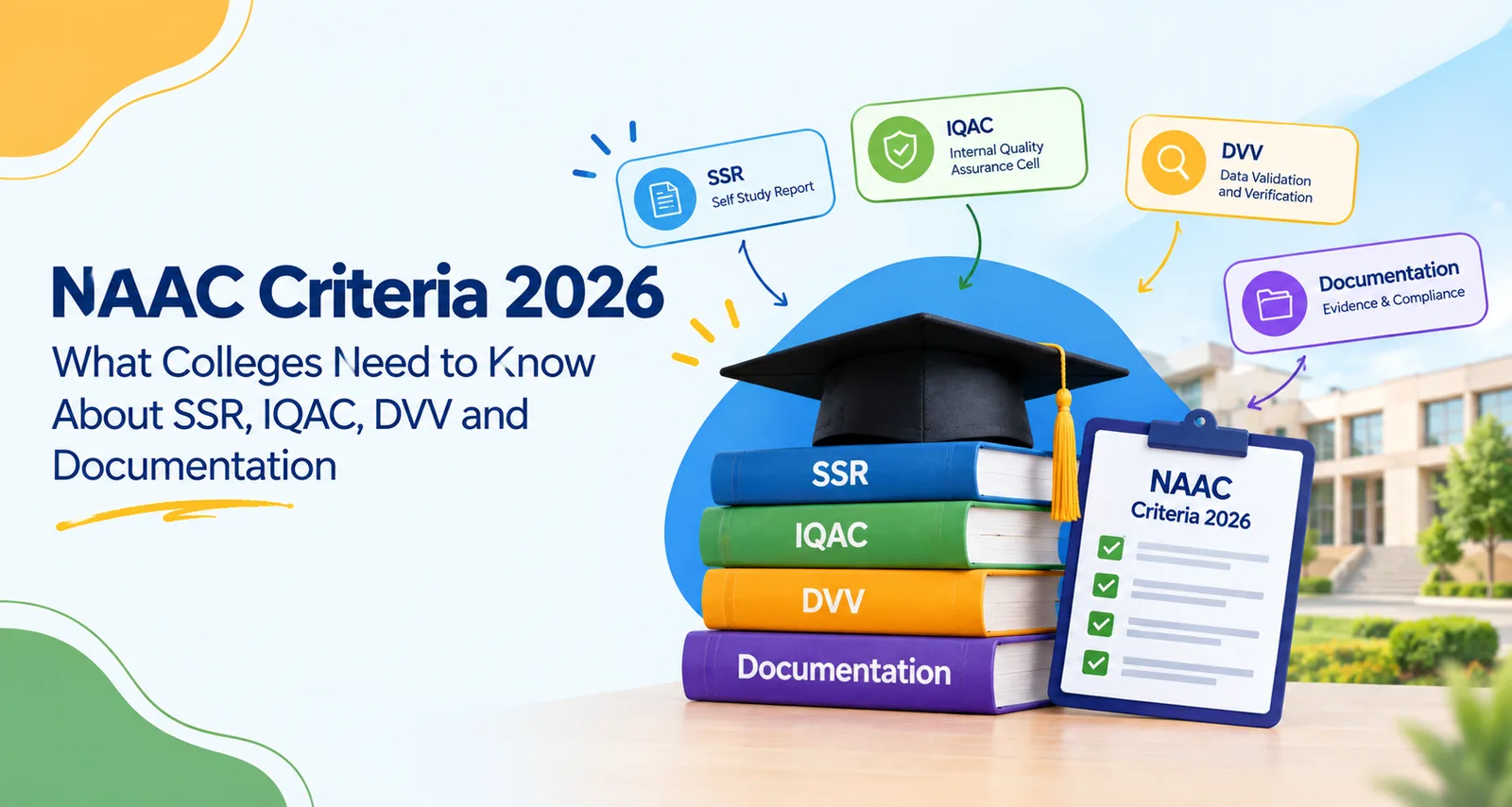
The Seven NAAC Criteria Explained: A Practical Guide to SSR, IQAC, DVV, Documentation and Evidence
For many higher education institutions, NAAC preparation does not become difficult because people do not know what the institution has been doing.
The real challenge begins when someone asks a simple question:
Can you prove it?
A college may have organised dozens of seminars, conducted student development programmes, supported faculty research, carried out extension activities, collected feedback and introduced new academic initiatives.
But if the supporting records are scattered across departments, personal computers, email accounts and cloud folders, finding the right evidence can become surprisingly difficult.
One person has the photographs.
Another has the attendance sheet.
Someone else has the event report.
The approval letter may be in an old file.
And the person who knows where everything is may be unavailable when the information is needed.
This is why understanding the seven NAAC criteria is so important.
The criteria should not be viewed as seven separate sections that have to be completed merely for the Self Study Report. They represent different dimensions of institutional functioning.
They ask institutions to demonstrate how they approach curriculum, teaching, research, infrastructure, student support, governance and institutional values.
The precise requirements can vary according to the applicable NAAC framework and category of institution. Since NAAC processes, manuals and portals can change, institutions should always refer to the latest applicable official guidelines before preparing or submitting data.
With that context, let's examine the seven criteria from a practical perspective.
Criterion 1: Curricular Aspects
The first criterion focuses on the curriculum and the institution's role in implementing, supporting and improving it.
At first glance, this may appear straightforward.
Every recognised institution has a curriculum.
The more important question is how the institution contributes to the effective delivery and development of that curriculum within the authority available to it.
For an affiliated college, this may involve demonstrating how effectively the prescribed university curriculum is implemented.
An autonomous institution may have greater scope to demonstrate curriculum design, revision and innovation.
Consider an institution that introduces a course related to Data Analytics.
The syllabus is only one part of the story.
A more complete institutional record could answer questions such as:
What need led to the introduction of the course?
Was student or stakeholder feedback considered?
Was there an industry or employment-related requirement?
Did faculty members contribute to curriculum development?
Were the relevant academic bodies involved?
How was the syllabus reviewed?
What learning resources were developed?
This distinction is important.
NAAC documentation should not merely establish that an activity took place. Wherever the applicable metric requires it, the evidence should help establish the process, purpose and outcome associated with that activity.
Useful records may therefore include curriculum-related minutes, academic plans, feedback analysis, value-added programmes, certificate courses and other supporting documents required by the applicable framework.
Criterion 2: Teaching, Learning and Evaluation
Criterion 2 moves into the core academic experience of students.
Teaching plans are prepared.
Classes are conducted.
Internal assessments take place.
Examinations are held.
Results are published.
But effective documentation needs to show more than the existence of these activities.
Institutions may need to demonstrate how they respond to different learning requirements, use teaching strategies, monitor student performance and improve learning outcomes.
Imagine a class of 60 students in which 12 students perform poorly in a particular subject.
One approach would be to record the marks and continue with the next semester.
Another would be to identify students requiring additional support, organise remedial instruction, provide supplementary resources and monitor their subsequent performance.
The second approach produces a clearer evidence trail.
The supporting records might include:
Identification of students
Remedial teaching schedule
Attendance records
Faculty documentation
Additional learning material
Follow-up assessments
Performance analysis
The important principle is that such records should emerge from genuine academic processes.
Creating paperwork retrospectively merely to satisfy accreditation requirements can create inconsistencies and weaken the credibility of the evidence.
Criterion 3: Research, Innovations and Extension
When research is discussed, publications are often the first thing that comes to mind.
However, Criterion 3 covers a broader range of institutional activities, depending on the applicable assessment framework.
These can include research, innovation, consultancy, collaboration, extension and community-oriented initiatives.
Consider a student extension programme conducted in a local community.
A photograph of the event demonstrates that something took place.
But a stronger evidence set can provide the complete context.
For example:
Activity proposal
Institutional approval
Programme notice
Participant details
Attendance record
Photographs
Activity report
Feedback
Outcomes
Follow-up documentation
Together, these records show planning, participation, implementation and results.
Research documentation works in much the same way.
A publication list may be important, but institutions should also maintain whatever supporting information is required for the relevant NAAC metric.
Records relating to funded research, publications, patents, consultancy, collaborations, innovation activities and research projects should ideally be maintained throughout the assessment period rather than reconstructed shortly before SSR submission.
Criterion 4: Infrastructure and Learning Resources
Infrastructure is often one of the easiest areas to understand because much of it is physically visible.
There are classrooms.
Laboratories.
Libraries.
Computers.
Sports facilities.
Digital resources.
But possession of infrastructure is only one part of the picture.
The institution should also be able to demonstrate how resources are maintained, upgraded and utilised.
For example, suppose a computer laboratory contains 50 systems.
A photograph establishes that the laboratory exists.
It does not necessarily demonstrate how the facility supports student learning.
Depending on the applicable requirements, useful supporting records could include:
Asset registers
Laboratory usage records
Timetables
Software availability
Maintenance records
AMC documentation
Purchase records
Upgradation details
Student utilisation information
The same principle applies to libraries.
A library is not simply a collection of books.
Its relevance also depends on how resources support teaching and learning, how students access physical and digital materials, and how library services are managed.
The broader lesson is straightforward:
Infrastructure is not only about what the institution owns. It is also about how those resources are maintained and used.
Criterion 5: Student Support and Progression
Criterion 5 focuses on the student journey beyond classroom instruction.
Consider a student who enters college after completing school.
During the following years, the institution may provide scholarships, mentoring, counselling, career guidance, internships, skill-development programmes, competitive-examination support and other services.
These activities form part of the student's overall institutional experience.
Suppose the college organises coaching for competitive examinations.
A photograph from the programme provides some evidence.
A more complete record might include:
Programme announcement
Student registration
Attendance
Schedule
Resource-person information
Learning material
Feedback
Outcomes
Follow-up activities
The same principle applies to mentoring.
Having a mentoring policy is different from demonstrating that mentoring is actually taking place.
Student progression data is also important.
Depending on the applicable NAAC requirements, institutions may need reliable information relating to areas such as higher education, employment, placements, internships, entrepreneurship and other progression outcomes.
This makes accurate student records particularly important.
Criterion 6: Governance, Leadership and Management
Criterion 6 looks at the institution from an organisational and management perspective.
It considers areas such as leadership, planning, decision-making, human-resource management, financial administration and institutional development.
A strategic plan is useful.
But a strategic plan sitting inside a file does not demonstrate implementation.
Suppose an institution establishes a three-year objective to strengthen research.
What happened after the plan was approved?
Perhaps the institution introduced research incentives.
Perhaps faculty development programmes were organised.
Perhaps seed funding was made available.
Perhaps research proposals increased.
Perhaps the institution reviewed progress periodically.
This creates a meaningful sequence:
Plan → Implement → Monitor → Review → Improve
That sequence is much more informative than simply presenting the original strategic document.
This is also where institutional leadership and IQAC need to work together.
Quality assurance becomes meaningful when observations and recommendations lead to actual institutional action.
Criterion 7: Institutional Values and Best Practices
Criterion 7 is sometimes treated as a collection of miscellaneous activities.
It is better understood as an opportunity to demonstrate the values reflected in institutional practice.
Depending on the applicable framework, this can involve areas such as:
Gender equity
Environmental sustainability
Inclusiveness
Accessibility
Professional ethics
Community engagement
Social responsibility
Institutional best practices
Consider an institution that describes itself as environmentally responsible.
What demonstrates that commitment?
It might have solar energy systems.
It might operate waste-segregation practices.
It might have rainwater harvesting.
It might conduct environmental awareness programmes.
It might involve students in sustainability initiatives.
The important point is to demonstrate the actual practice with appropriate evidence rather than relying solely on a statement.
The same applies to best practices.
A best practice does not necessarily need to be an elaborate or expensive innovation.
It can be a well-designed institutional process that is implemented consistently and produces a meaningful result.
Where Does the SSR Fit?
All of these activities eventually connect with one of the most important components of the NAAC process: the Self Study Report (SSR).
The term itself provides a useful clue.
It is a self-study.
The institution is essentially documenting:
What it does
How it does it
What evidence supports those activities
What results have been achieved
What improvements have been made
Where further improvement is required
For this reason, an SSR should not be treated simply as a form to complete.
Ideally, it should be the outcome of institutional data collection, documentation, analysis and reflection carried out over time.
A broad statement such as:
"The institution promotes faculty development."
does not provide much measurable information by itself.
A stronger institutional record can provide relevant details such as the number of programmes conducted, participation, areas covered and outcomes, where those details are required by the applicable metric.
The difference is important.
One is a claim.
The other is a claim supported by information that can be examined.
IQAC: Keeping Quality Improvement Continuous
The Internal Quality Assurance Cell (IQAC) plays an important role in maintaining institutional quality processes.
Its role should not be reduced to preparing the SSR whenever an accreditation cycle approaches.
A functioning IQAC can help coordinate quality initiatives, encourage good practices, review feedback, monitor institutional activities, maintain appropriate records and support continuous improvement.
Ideally, quality assurance should continue throughout the academic year.
A practical cycle can look like this:
Plan → Implement → Record → Review → Improve → Repeat
This is very different from waiting for an accreditation notification and then beginning an intensive document-collection exercise.
The strongest documentation systems are built into normal institutional operations.
Understanding DVV
Another important part of the NAAC process is Data Validation and Verification (DVV).
The basic idea is that institutional data and claims may be subjected to validation and verification in accordance with the applicable assessment process.
This makes consistency extremely important.
Suppose an institution reports one figure in one location and a different figure elsewhere.
That inconsistency may require clarification.
Similarly, if a submitted document does not adequately support a claim, or if dates and other details do not match across records, additional questions may arise.
A useful principle for institutions is therefore:
Never report a figure because it appears impressive. Report it because the institution has reliable evidence to support it.
Accurate data is more valuable than inflated data.
Documentation: Build It When the Activity Happens
One of the most common administrative problems is postponing documentation.
The thinking often goes something like:
"We have the activity records somewhere. We'll organise everything later."
The problem is that "later" usually arrives when an accreditation deadline is approaching.
A better approach is to document activities as they happen.
For example, if a department conducts a seminar in September, its evidence can be organised immediately:
Approval → Notice → Registration → Attendance → Photographs → Report → Feedback → Outcome
The same approach can be applied to workshops, FDPs, extension programmes, student activities, committee meetings, research initiatives and other institutional events.
Over time, this creates something more valuable than a collection of files.
It creates institutional memory.
The Five-Minute Evidence Test
A useful way to assess NAAC readiness is to ask:
If someone asks for a particular piece of evidence right now, can the institution locate it within five minutes?
If the answer is yes, the documentation system is probably functioning reasonably well.
If the answer is no, the institution may need to improve how its records are organised.
This is one area where digital NAAC management systems can provide practical support.
Technology cannot create genuine institutional activities or manufacture valid evidence.
What it can do is help organise existing records by criteria, departments, activities, metrics and reporting requirements.
For institutions trying to move away from scattered folders and last-minute evidence collection, a dedicated NAAC management platform can provide a structured environment for managing documents, reports and institutional data.
Sonet Microsystems provides a NAAC management platform that institutions can explore through its free trial.
A More Practical Way to Look at NAAC
After considering the seven criteria, SSR, IQAC, DVV and documentation, the entire process can be reduced to one simple chain:
Activity → Evidence → Data → Review → Improvement
Every link matters.
An activity without documentation becomes difficult to demonstrate.
Documentation without analysis may provide little insight into improvement.
Data without review may become nothing more than a collection of numbers.
And review without action limits the value of quality assurance.
This is why effective NAAC preparation should not begin only when an accreditation notification arrives.
It should be part of routine institutional administration.
The goal is not to create enormous files or produce paperwork for its own sake.
The goal is to develop a reliable system in which the institution's genuine work is recorded, organised, reviewed and available when needed.
When that system is in place, NAAC preparation becomes less about searching for missing documents and more about presenting an accurate picture of what the institution actually does.
Good NAAC preparation is ultimately not about having more documents. It is about having the right evidence, organised at the right time, and connected to genuine institutional improvement.