
College ERP vs School ERP: What's Actually Different?
By Sonet Microsystems
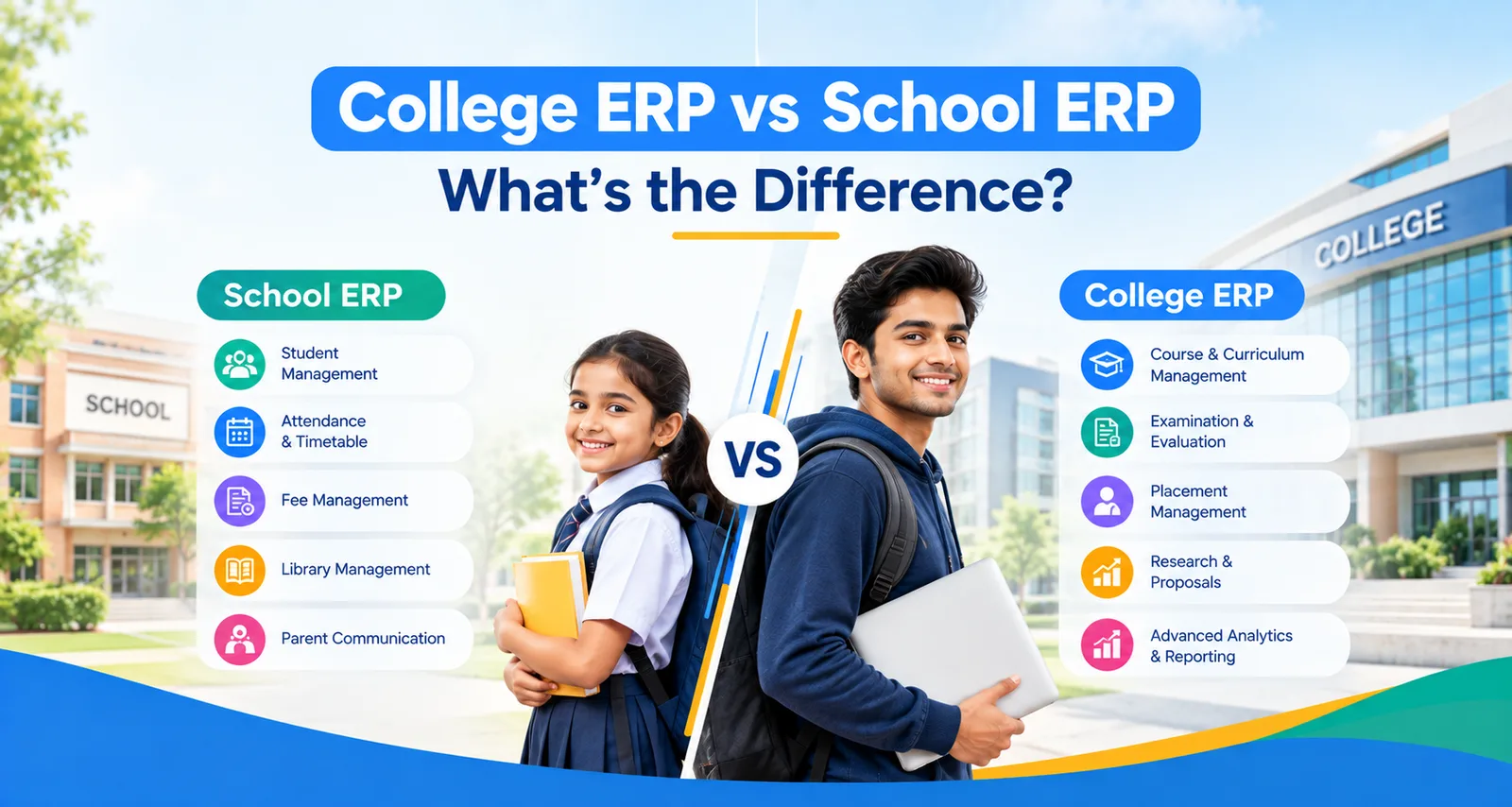
If you search for "college ERP" and "school ERP" side by side, most vendor websites make them sound interchangeable; swap the logo, change the word "student" to "learner," done. In practice, the two solve different day-to-day problems, because a college and a K-12 school are run very differently.
Where the real differences show up
1. The unit of academic structure
A school runs on classes and sections - Class 8-B, Class 10-A with a fixed daily timetable across subjects. A college runs on programmes, semesters and credits, where a student's timetable is unique to the electives they have chosen. A school ERP like Sonet's eSSMS is built around class-section-subject; a college ERP like ESCOP is built around programme-semester-credit. Trying to force one model into the other is where a lot of generic software falls apart.
2. Who the "parent" audience actually is
School ERPs put enormous weight on parent communication, homework updates, bus tracking, fee reminders, attendance alerts, because the primary users below the admin layer are children who are not managing their own enrolment. College ERPs shift that weight toward the student directly: self-service portals for course registration, exam forms, hostel allocation and placement applications.
3. Examinations look completely different
School examinations are internal, term-based and tied to a report card format mandated by the board (CBSE, ICSE, state boards). College examinations involve external evaluators, internal-external marks splits, backlog and re-appear management, and grade point calculations that feed into a final CGPA. A school ERP's exam module and a college ERP's exam module are, functionally, different products wearing the same name.
4. Compliance reporting
Colleges answer to UGC, AICTE, NAAC and NBA. Schools answer to their board and, depending on the state, to a state education department. The compliance modules genuinely don't overlap much.
Where they're the same
Underneath the academic layer, a lot is shared: fee collection and reconciliation, HR and payroll, biometric attendance, transport/GPS tracking, and the general admin dashboard a principal or registrar uses to see what's happening across campus. This is exactly why Sonet builds eSSMS and ESCOP on the same underlying platform rather than as two unrelated products, an education group running both a college and a school under one trust gets one vendor, one data model and one support team, instead of stitching two disconnected systems together.
If you run both a school and a college
This is the case where the distinction matters most in practice. Institution groups that run a school and a college or a school, a college and a university under one trust or society usually end up worse off buying "best of breed" separately, because student records, staff records and finance never talk to each other across the group. Standardizing on one vendor whose products share a core, even if the front-end modules differ by education level, tends to save far more admin time than picking the single best tool for each individual campus.